Explore Shun Education
Product Insights
Dual Core: Sharpness Redefined
Knife Knowledge
Damascus, Tsuchime & San Mai Edge
Use & Maintenance
Recipes
Blog
Why Shun Knives Feel So Different
Knife Anatomy and the Perfect Chef’s Grip
Essential Knife Cuts Every Home Chef Should Master
Knife Techniques for Everyday Ingredients
A Culinary Conversation with Chef Vitor Mendes
Kitchen Knife Anatomy: Understanding Each Part
Kitchen knife anatomy refers to the different parts of a knife, from the blade and edge to the handle and tang. Each part affects how the knife cuts, feels in the hand, and performs over time, which is why understanding knife anatomy can help you choose, use, and care for your knives with more confidence.
Key Takeaways
- A kitchen knife is made up of blade, handle, and connecting components that each affect performance.
- Blade parts such as the edge, tip, spine, and heel influence precision, strength, and cutting style.
- Handle components such as the tang, bolster, and rivets affect balance, comfort, and control.
- Understanding knife anatomy can help you choose the right knife and care for it properly.
- Good knife design brings form and function together in a way you can feel every time you cook.
Parts of a Kitchen Knife
A kitchen knife may look simple at a glance, but every part has a purpose. Some features affect how the knife cuts. Others influence how it feels in the hand, how balanced it is, and how comfortable it remains through repeated use.
Understanding those parts makes it easier to evaluate a knife not only by appearance, but by how it is designed to perform.
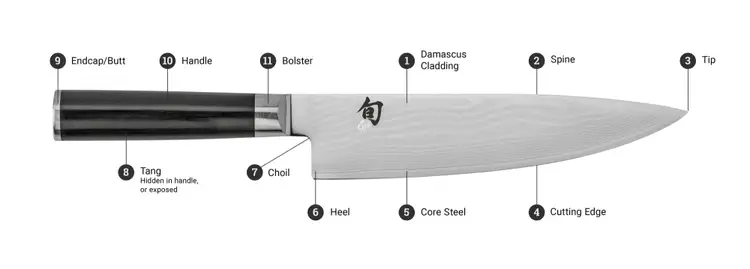
What Each Part of a Knife Does
Each part of a kitchen knife contributes something different to performance.
The cutting edge does the work of cutting. The tip supports precision. The heel adds strength. The spine contributes structure and feel. The core steel influences edge performance, while Damascus cladding helps support the blade and contributes to its distinctive appearance. The choil, handle, tang, and bolster all help shape balance, comfort, and control.
When these elements are well designed, the knife feels more natural in use. That is part of what makes a well-crafted knife so satisfying to cook with: every detail is working together.
How Knife Anatomy Affects Performance
Knife anatomy affects more than appearance. It shapes the way a knife feels in the hand, how confidently it moves through ingredients, and how comfortably it performs over time.
A well-formed cutting edge supports cleaner cutting. A strong core steel helps define the knife’s edge performance. A balanced tang and handle help the knife feel stable and controlled. A comfortable grip makes prep easier and more natural. Even small details, such as the choil or bolster, can change how the knife feels during repeated use.
That is why knife anatomy matters. It helps explain not only what a knife is made of, but why some knives feel more precise, more comfortable, and more rewarding to use.
Frequently Asked Questions
What are the parts of a kitchen knife?
The main parts of a kitchen knife include the tip, spine, cutting edge, core steel, heel, choil, tang, handle, bolster, and endcap. Some knives also feature Damascus cladding around the core steel.
What does each part of a knife do?
Each part serves a different purpose. The cutting edge cuts, the tip supports precision work, the heel adds strength, the spine contributes structure, and the handle components affect balance, grip, and comfort.
Why is knife anatomy important?
Knife anatomy is important because it affects performance, control, and comfort. Understanding the parts of a knife can help you choose the right knife, use it more confidently, and care for it properly over time.
Continue Learning
Understanding kitchen knife anatomy is just one part of proper knife ownership. To keep your knife performing at its best, learn how to properly use and maintain it in our knife care guide, and explore sharpening vs honingto keep your edge aligned and sharp.